Backing up into the kitchen floor sink, overflowing at the manhole, or a dish pit that will not drain mid service. Send the form with your address and what you are seeing. Say it is urgent in the first line.
Stop using the sinks and dish machine that feed the trap. Rope off any wet floor and keep food prep clear of it. Do not pour drain cleaner or boiling water into the trap. Then send the contact form with your address, what you are seeing, and whether you are still trading. That is the fastest path to a truck.
What is actually happening when a trap backs up
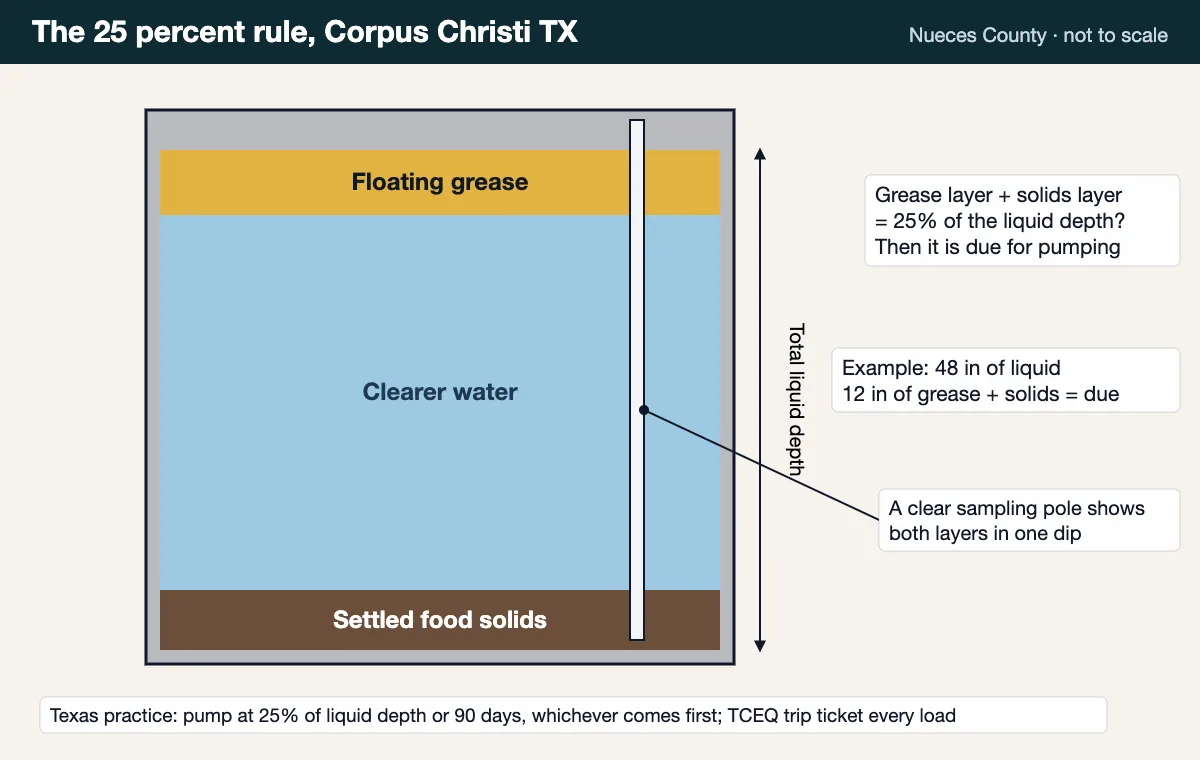
A backup is a full tank: the grease cap and solids layer squeeze the clear water zone until the outlet clogs and water comes back up the lowest drain.
A grease trap holds a fixed volume. As the grease cap thickens at the top and the solids layer builds at the bottom, the clear water column in the middle gets thinner. Wastewater passes through faster because there is less room, separation stops working, and grease starts leaving with the effluent.
Left long enough, one of two things happens. Either the tank itself reaches the point where it cannot accept the inflow during a busy service and water backs up through the lowest opening in the system, which is usually a kitchen floor sink or floor drain. Or the grease that escaped downstream cools in the lateral, hardens against the pipe wall, and builds a restriction that eventually closes the line entirely.
The first is a trap problem and a full pump-out fixes it in an hour. The second is a line problem and needs jetting. They present almost identically from the kitchen floor, which is why guessing is expensive. Pump, watch how the system behaves once the tank is empty, and that tells you which one you have.
Signs you are about to have one
A floor drain or floor sink that empties slower than it used to, especially during the dinner push when flow is highest.
Gurgling from the mop sink or the dish pit when another fixture drains.
Sewer odor in the kitchen that gets worse on hot afternoons, or odor reaching the dining room or patio.
Visible standing water or seepage around an indoor trap lid.
Wet ground or staining around an outdoor interceptor manhole.
Flies or fruit flies congregating near a drain or trap access point.
A dish machine cycle that leaves water standing in the pit longer than normal.
Any one of these on its own is worth a look. Two or three together means the trap is near capacity and you are on a countdown to a service interruption. A pump-out booked on a Tuesday morning costs a fraction of one done at 8pm on a Saturday with a full dining room waiting.
What it costs you to wait
Grease that gets past an overfull trap hardens in the pipes downstream, where clearing it costs far more than the pump-out would have.
The pump-out itself is the smallest number in the situation. The real cost is what sits around it.
Lost service
A Corpus Christi restaurant that has to stop seating for an evening loses the covers, the bar spend, and the staff wages already committed for that shift. For a busy downtown or Water Street room on a weekend that is a significant number before anybody has touched a wrench.
Line jetting
If grease has already hardened in your lateral, clearing it is a separate job with a separate crew and a separate bill. And it is not a one time fix, because if the trap that caused it stays on the same neglected schedule, the line will close again.
Regulatory exposure
Wastewater on a kitchen floor is a food safety issue and inspectors treat it as one. A discharge that reaches a storm drain or a parking lot is a separate and more serious problem, because grease and wastewater leaving your site is an environmental discharge, not a plumbing inconvenience. Sanitary sewer overflows caused by grease are one of the things municipal FOG programs exist to prevent, and a site that causes one gets attention afterwards.
Reputation
Sewer smell in a dining room ends up in reviews. That damage outlasts the plumbing bill by a long way.
Across the Coastal Bend
This site covers Corpus Christi and Nueces County, including Downtown and the Water Street district, North Beach, the South Side and the SPID corridor, Flour Bluff, Calallen, and Padre Island, plus Portland and San Patricio County across the Harbor Bridge.
Island and bayfront sites are worth flagging when you send the form. Causeway traffic and, in summer, beach traffic affect how long a truck takes to reach Padre Island, and an outdoor interceptor lid near the bay that has corroded shut adds real time on arrival. Neither rules out service, but knowing in advance means the crew arrives with the right kit rather than making a second trip.
The fix that stops it repeating
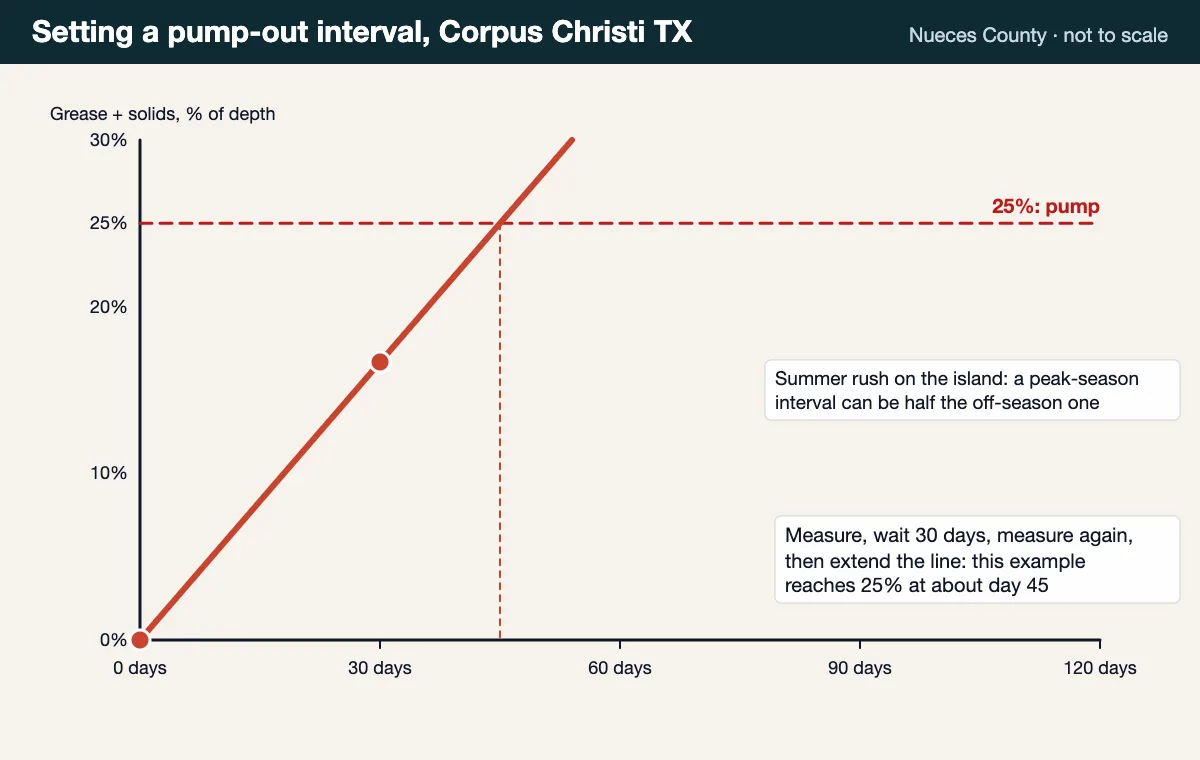
The fix after an emergency is an interval: two measurements, a fill line and a visit booked before the 25 percent mark.
An emergency pump-out gets you trading again. It does not address why the tank was overloaded, and in nearly every case the answer is that the service interval was set by habit or by a hauler's route convenience rather than by what the kitchen actually produces.
After it is cleared, ask for the measured depths and what interval those numbers imply. Putting the site on a scheduled route at the correct cadence is the whole prevention strategy. There is nothing clever about it, and it works.
Anything that is stopping service or creating a health or safety risk right now. Wastewater coming up through a floor sink or floor drain. Standing water around a trap lid. An interceptor overflowing at the manhole into a parking lot. A dish pit that will not drain during service. Strong sewer odor in a dining room. If you are asking yourself whether it is bad enough to call, it is.
Should I keep the kitchen open while it backs up?
Generally no, not on the affected side. Wastewater on a kitchen floor is a contamination risk over food contact surfaces and a serious slip hazard for staff carrying hot pans. Stop using the fixtures feeding the trap, rope off the wet area, and keep food prep away from it. A short closure you controlled is far better than a health inspection finding you operating in it.
Will pumping the trap definitely fix a backup?
It fixes the ones caused by an overloaded tank, which is the majority. It does not fix a blockage further down the lateral or out at the city connection. How the tank behaves once it is emptied usually tells you which you have. If water still will not move after a full pump-out and a line flush, the restriction is downstream and you need a jetting crew, not a second pump-out.
What information do you need to move fastest?
Address, what you are seeing and where, whether the kitchen is currently trading, trap size if you know it, and whether the access is indoor under a sink or an outdoor manhole. If you can add roughly when the trap was last serviced, that says a lot about what the crew is walking into.
Do emergency visits cost more?
An out of hours or same day priority visit prices higher than a scheduled route slot, which is normal across the trade. What you should not accept is an unquoted figure. Ask for the number before dispatch even on an emergency, so you can make the call with the cost in front of you rather than after the fact.
Can I use a drain cleaner or hot water to clear it myself?
Do not pour caustic drain product into a grease trap. It does not remove the grease, it makes an already regulated waste stream more hazardous for whoever pumps it next, and it can damage tank fittings. Flushing very hot water through is worse than useless: it liquefies the grease cap so it passes out of the trap and re hardens further down the line, converting a trap problem into a lateral problem.
Address, what you are seeing, whether you are still trading, and trap size if you know it. Ask for the price before dispatch, even on an emergency, so you are not guessing at the cost.