Two triggers govern it, whichever arrives first: 25 percent of liquid depth, or 90 days. Here is what that means in a working Texas kitchen, and how to measure your own interval instead of inheriting somebody's default.
Grease trap pumping frequency in Texas comes down to two triggers: 25 percent of the liquid depth, or 90 days, whichever comes first.
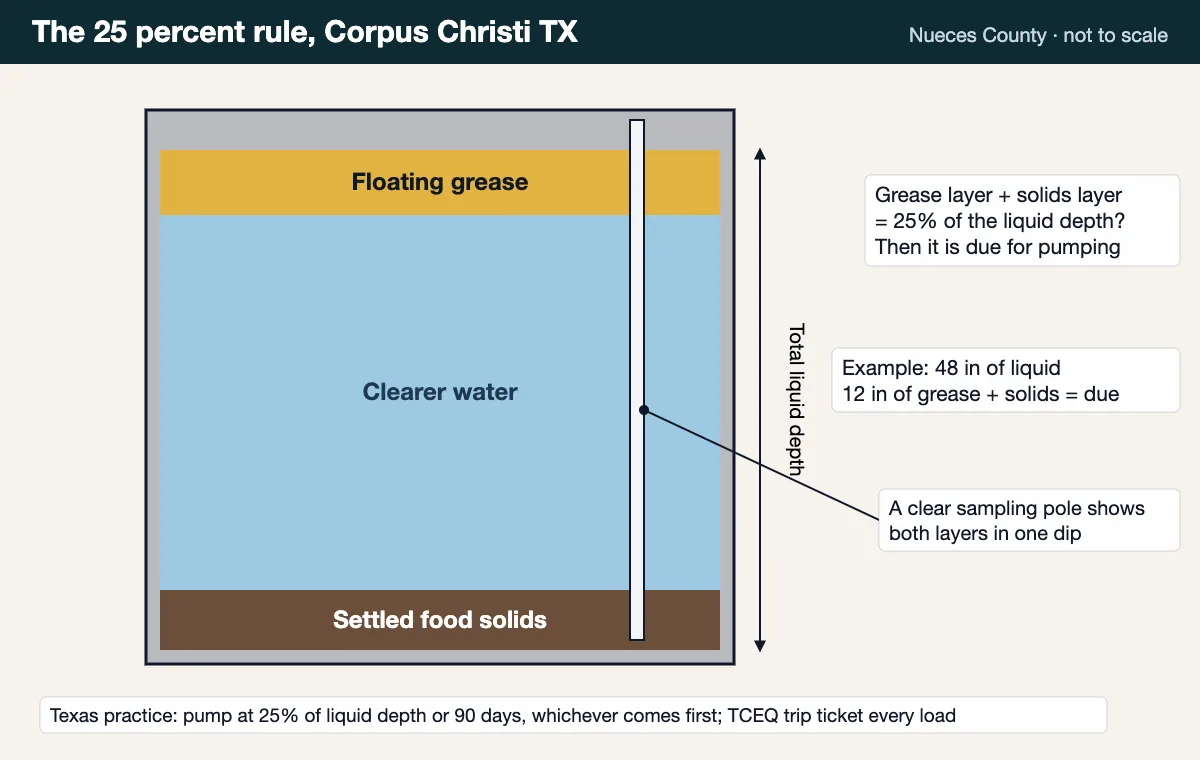
A grease trap in Texas has to be cleaned when the accumulated grease and solids reach 25 percent of the total liquid depth, or at least once every 90 days, whichever comes first. Both halves of that sentence matter, and most operators only carry the second one around in their head.
The 25 percent figure is not arbitrary. A trap separates by retention: wastewater has to sit still long enough for grease to rise and solids to settle before the water leaves through the outlet. As the cap thickens and the sludge builds, the clear water column between them shrinks, retention time collapses, and the tank stops separating. At around a quarter of the depth occupied, performance degrades sharply. Past that, you own a very expensive length of pipe.
The distinction that costs restaurants money
90 days is the legal ceiling. 25 percent is the operational reality. A fry heavy kitchen in Corpus Christi crosses 25 percent in three to four weeks. Somebody servicing that kitchen quarterly is not keeping it compliant, they are running it out of compliance for roughly two months out of every three.
Work out your own interval in two measurements
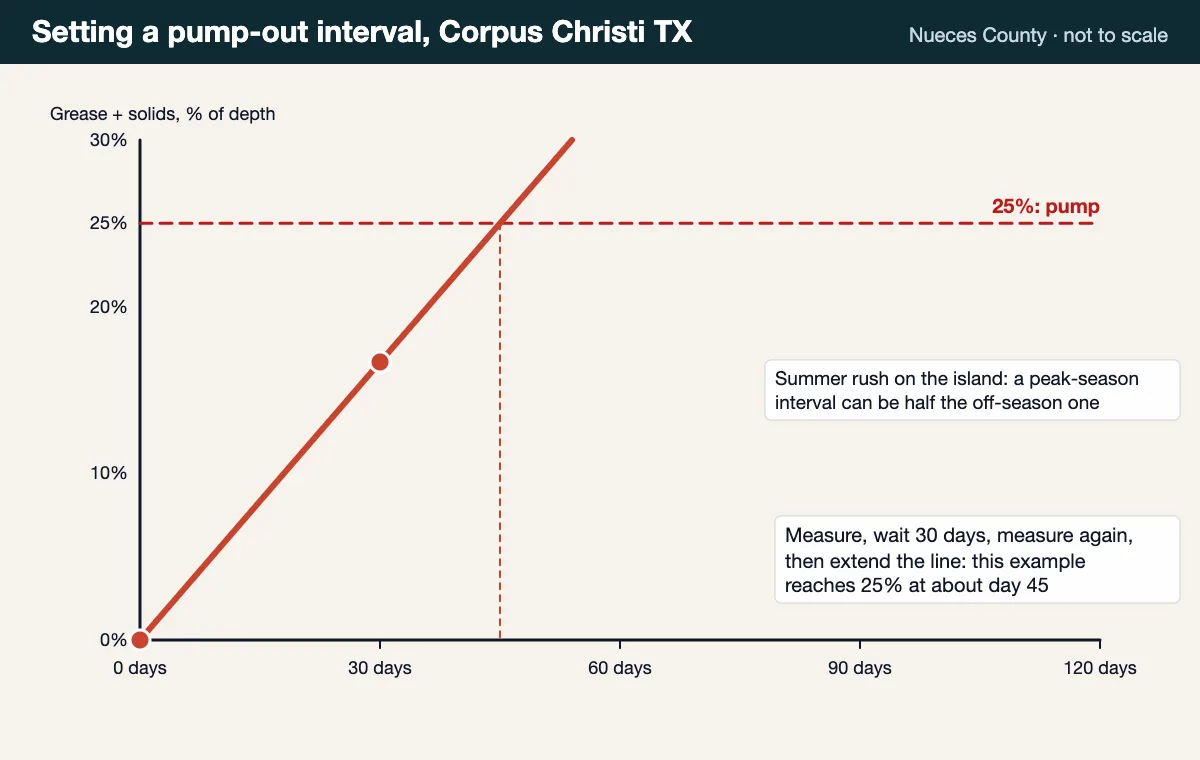
Measure, wait 30 days, measure again, then extend the line. In this example the tank reaches 25 percent at about day 45.
You do not need an expert for this. You need a clean length of PVC, a tape measure, and two dates.
Step one: have the tank fully cleaned and note the date. It starts at zero.
Step two: wait a known period, say 30 days, then measure. Lower the PVC to the bottom, cap the top with your thumb, lift it out, and read the layers.
Step three: add the grease depth and the solids depth, then divide by the total wet length on the stick. That is your percentage.
Step four: divide that percentage by the number of days elapsed. That is your daily loading rate.
Step five: divide 25 by your daily rate. That is the day you hit the trigger. Set your interval a little inside it.
Worked example. Tank cleaned on the first. Measured on day 30 at 18 percent. Daily rate is 0.6 percent. 25 divided by 0.6 is about 42 days. Set the interval at 35 days to leave margin for a busy week. That number is now specific to your kitchen, your menu, and your equipment, and it will beat any generic recommendation including ours.
Typical intervals by kitchen profile
These are starting points for a Corpus Christi kitchen on a correctly sized tank. Use them until you have your own measurements, then replace them.
Fried seafood house
Very high load
2 to 4 weeks
Full service restaurant with fryer
High load
4 weeks
Taqueria or griddle heavy kitchen
High load
4 to 6 weeks
Bar with a food menu
Moderate load
6 to 8 weeks
Cafe, sandwich or salad counter
Low to moderate load
8 to 12 weeks
Bakery with minimal fry
Low load
10 to 12 weeks
What actually changes your loading rate
Menu and cooking method
Fryers dominate. A kitchen running two fryers through lunch and dinner loads its trap several times faster than an equivalent volume kitchen doing grilled and roasted work. Griddles, woks, and anything involving rendered animal fat follow close behind. Salad, cold prep, and baked service barely register by comparison.
Volume and covers
Obvious but worth stating: loading scales with how many plates leave the pass. A restaurant that doubles its covers has roughly halved its interval, and that transition frequently happens without anybody revisiting the service schedule.
Tank size relative to the kitchen
An undersized trap fills fast and no amount of good practice fixes it. This is common in spaces that changed concept without changing plumbing. If you are on a three week cycle and still struggling, the problem may be specification rather than scheduling.
Kitchen practice
Dry wipe pans and plates before they reach the dish pit. This is the single highest impact habit available to a kitchen.
Scrape solids into the bin rather than rinsing them down. Solids build the sludge layer that quietly eats your capacity.
Fit and actually use sink strainers on every compartment.
Never pour used fryer oil down any drain. It goes into the rendering container, which is often a revenue item rather than a cost.
Keep the trap lid accessible so a proper clean is possible. A buried lid produces bad cleans forever.
Season
Real and significant on the coast. Padre Island, North Beach, and bayfront restaurants carry summer volumes that bear no relation to January. Running two intervals across the year, tighter through the peak and longer in the off season, is more accurate and usually cheaper than one flat schedule.
Over servicing is a real cost too
A light-use kitchen arriving at 8 or 10 percent each visit is paying for pump-outs it does not need yet.
This page is mostly about kitchens being serviced too rarely, because that is the more damaging failure. The opposite exists though. If your tank is consistently at 8 or 10 percent when the truck arrives, you are buying visits you do not need. A hauler who never tells you that is not acting in your interest.
Measuring on every visit solves both directions. Recording the depths before pumping on every job means the interval moves out when your tank says it should, not just in. See the cost guide for what that difference is worth across a year.
Where to start if you have no data at all
Book a full clean, get the depths measured and written on the ticket, then book the second visit at 30 days. After two visits you have a real interval and you never have to guess again. Most Corpus Christi kitchens settle on a 30 or 60 day route and stop thinking about it entirely.
Service is due when the combined depth of the floating grease layer and the settled solids layer reaches 25 percent of the total liquid depth of the tank. It is a capacity rule, not a calendar rule. The logic is that once a quarter of the working volume is occupied by accumulated material, the remaining clear water column is too short for reliable separation, so grease starts escaping downstream even though the tank is technically still functioning.
So is the 90 day rule irrelevant?
It is a backstop, not a target. The requirement is service at 25 percent or at least every 90 days, whichever comes first. For a low grease operation with a generously sized tank, 90 days may genuinely be the binding constraint. For a fry kitchen it will never be, because 25 percent arrives in a fraction of that time. Operators who only remember the 90 day figure are the ones who end up with a backup.
How do I measure the layers myself?
Use a clean length of PVC or a purpose made sludge judge. Lower it slowly to the bottom of the tank, cap the top end with your thumb to hold the column, and lift it out. You will see the grease layer at the top, the water in the middle, and the solids at the bottom. Measure the grease depth plus the solids depth, divide by the total wet length, and that is your percentage. Do it the same way each time so the numbers are comparable.
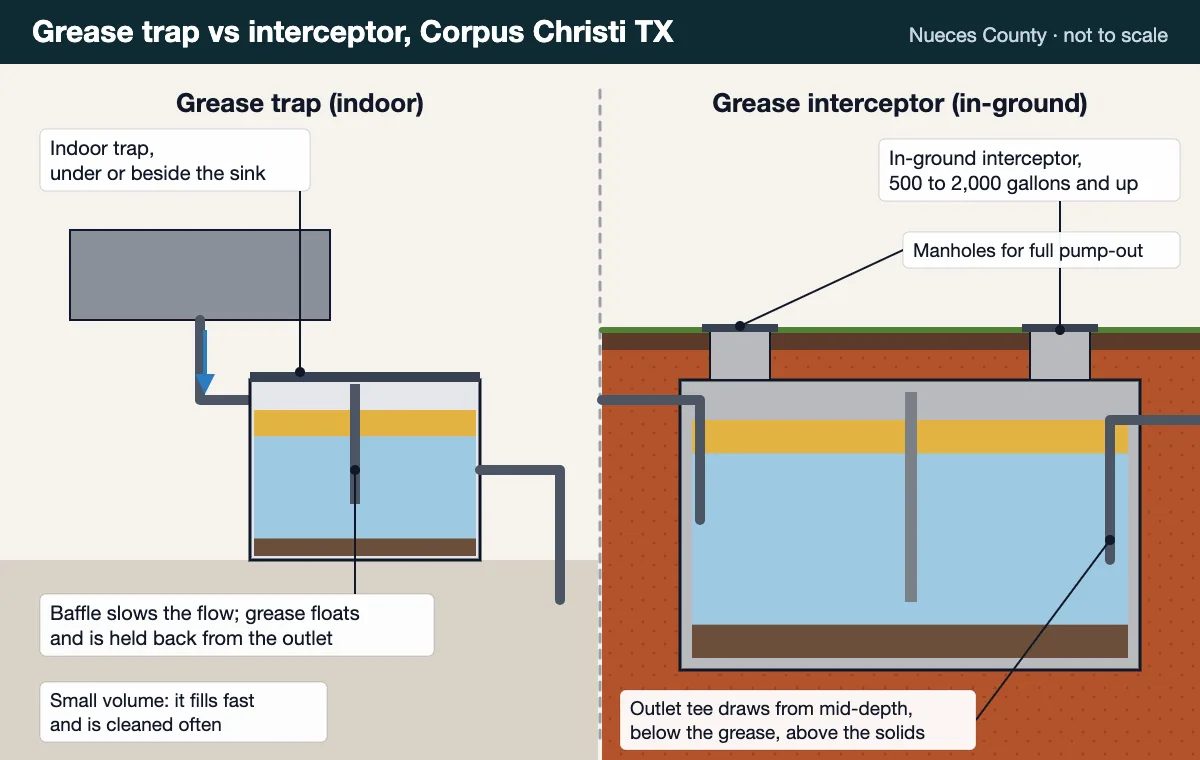
A small indoor trap can need monthly visits; a large interceptor serving the same kitchen may run the full 90 days.
How many measurements do I need to set an interval?
Two, taken a known number of days apart with no service in between. If your tank went from freshly cleaned to 20 percent in 40 days, your loading rate is roughly half a percent a day, so 25 percent arrives around day 50. Set the interval at 40 days to leave margin. That is the whole calculation, and it beats any rule of thumb because it uses your kitchen rather than an average one.
Does the season change my interval in Corpus Christi?
On the island and along the bayfront, noticeably. A Padre Island restaurant doing triple volume through the summer and a fraction of it in January is effectively two different kitchens on one tank. Running a 30 day interval through the peak and stepping to 60 days in the off season is usually correct and usually cheaper than holding one interval all year.
Can I stretch the interval if I am careful about what goes down the drain?
Good kitchen practice genuinely helps. Dry wiping pans before washing, scraping plates into the bin, using sink strainers, and never pouring fryer oil down a drain all reduce loading meaningfully. What it does not do is change the rule. You still service at 25 percent or 90 days, whichever comes first. Better practice moves the date the 25 percent line arrives, which lets a measured interval legitimately lengthen.
Ask for grease depth, solids depth, and total liquid depth to be measured before pumping on every visit, with the numbers on your ticket. After two visits your schedule is evidence, not habit.