Put your trap on a route and stop thinking about it. Pumping on a 30, 60, or 90 day cadence set by what your tank actually loads, with depths recorded every visit and the interval adjusted when your kitchen changes.
Grease trap pumping in Corpus Christi on a route is booked from the fill line, so the visit lands before the tank reaches 25 percent.
Almost every grease emergency in Corpus Christi has the same origin story. The kitchen was on an informal arrangement. Somebody used to call the hauler when the trap looked full. That somebody left, or got busy through a summer rush, and four months went past. Now the floor sink is backing up on a Saturday night and the restaurant is losing covers while a truck tries to get across town.
A scheduled route removes the human memory step. You get a fixed slot, the truck turns up, the tank gets emptied, the paperwork gets filed, and nobody on your team has to hold that task in their head alongside ordering, scheduling, and a health inspection. For a kitchen running thin on management bandwidth, that is most of the value.
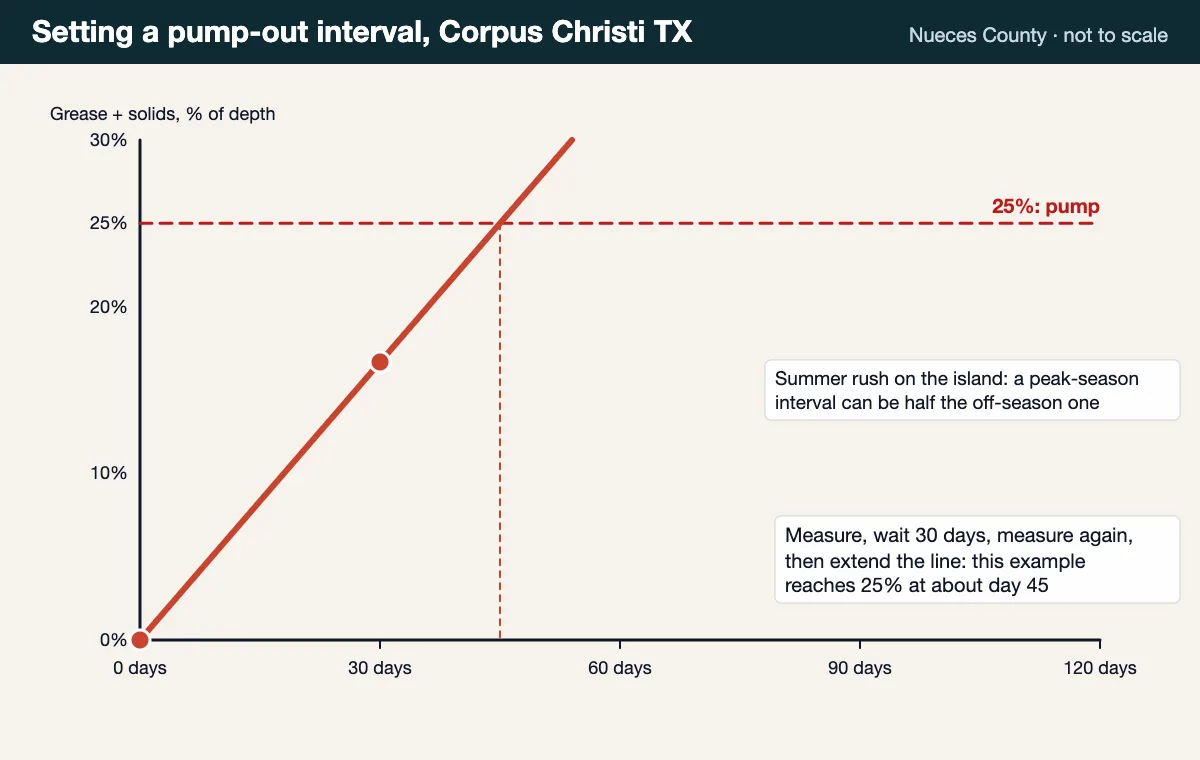
It also means the interval is based on evidence. Every visit should record the grease depth, the solids depth, and the total liquid depth before pumping. Across three or four visits that gives your actual loading rate, and the interval stops being a guess. Kitchens that assumed they needed monthly service sometimes go to six weeks. Kitchens on a quarterly schedule frequently discover they should have been monthly all along.
Two triggers, whichever comes first
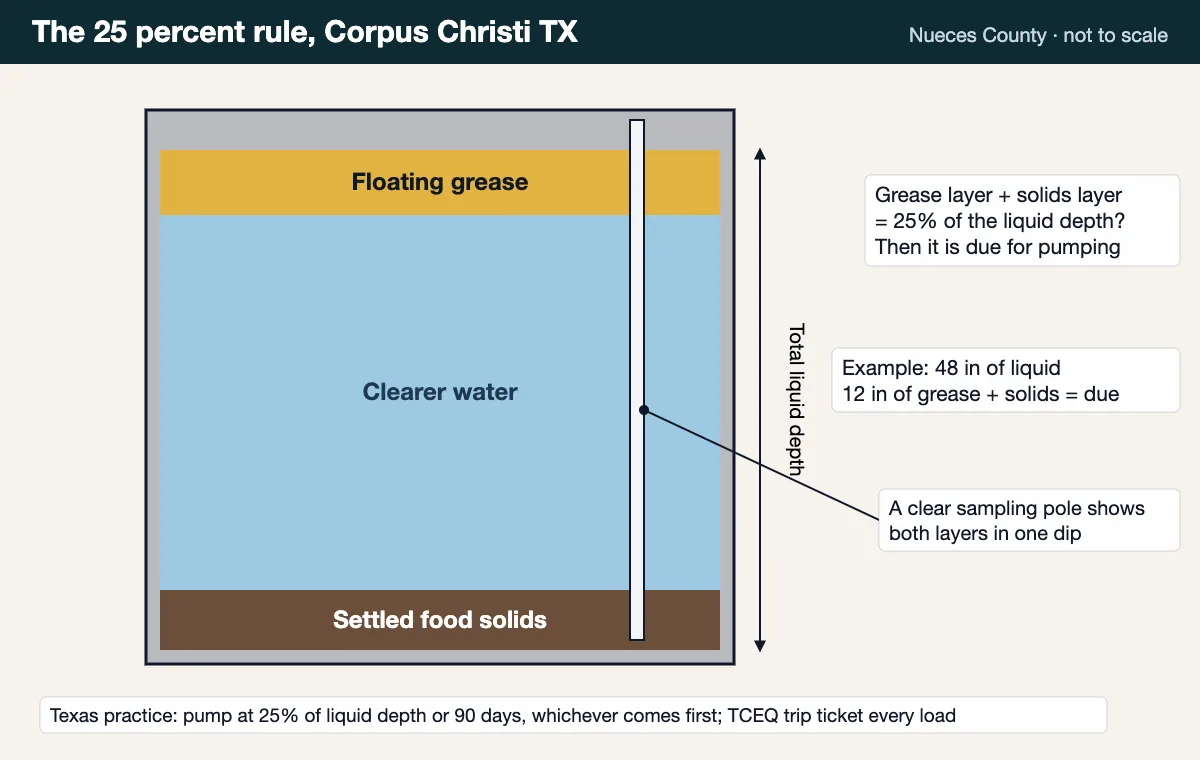
Texas requires service when grease and solids reach 25 percent of the total liquid depth, or at least every 90 days. The 90 days is a ceiling, not a target. Treating it as a target is the single most common compliance mistake in this market, because a busy fry kitchen crosses 25 percent in a fraction of that time.
What a route visit includes
Pre pump measurement: grease cap depth, solids depth, total liquid depth, recorded on the ticket so the trend is visible across visits.
Complete evacuation of the tank. Cap, water column, and bottom solids.
Wall and baffle scraping so the hardened film leaves with this load rather than seeding the next one.
Inlet and outlet line back flush.
Baffle and fitting inspection, with a note on the ticket if anything is cracked, eroded, or missing.
Lid, frame, and gasket condition check. This matters more near the bay than most operators expect.
Refill to operating level with clean water.
Signed trip ticket showing volume removed and the permitted disposal facility, left with you on site.
Nothing in that list is an add on line item. If a quote you are comparing prices baffle scraping or line flushing separately, add those in before you compare the headline number, because a pump-only visit that leaves a coated tank is not the same product.
Picking your interval
Texas practice adds a 90 day ceiling on top of the 25 percent rule, whichever comes first.
30 day routes
The default for most independent full service restaurants in Corpus Christi running a 50 to 100 gallon indoor unit. If you have a fryer running through lunch and dinner, a flat top, and a dish pit handling a couple of hundred covers a day, you will cross 25 percent inside a month. Seafood houses, taquerias with heavy griddle work, breakfast spots, and bar kitchens all tend to live here.
60 day routes
Suits kitchens with moderate volume or an oversized tank relative to their load. Coffee shops with a food menu, sandwich and salad counters, small cafes, and some restaurants that were built with a 500 gallon outdoor unit despite doing indoor unit volume. Also common for island restaurants through the slower winter months before they step back to 30 days for the summer.
90 day routes
The legal ceiling, and appropriate only for genuinely low grease operations with generous tank capacity. Think a bakery with minimal fry, a bar with no kitchen but a required trap on the bar sink, or a large interceptor serving a low volume tenant. If somebody has you on 90 days and your fryer runs all day, ask to see the depths from your last few visits.
The pumping frequency guide walks through how to work out your own interval from two consecutive measurements, which is worth doing even if you never book a service.
Multi site and shared interceptor routes
If you run more than one Corpus Christi location, a single route day covering all of them is cheaper and vastly easier to administer than separate appointments. Send every address and trap size together and ask for the day to be built around your service windows so no site gets hit at 7pm on a Friday.
Shared interceptors in strip centres along SPID and in the South Side are their own problem. One tank serves several tenants, the load is dominated by whichever tenant fries the most, and the cost split is a recurring argument. The invoice can usually be handled however the centre wants, whether that is a single bill to the landlord or a split across tenants, and the trip ticket records the whole load so nobody has to take anybody's word for it.
Coastal Bend coverage
Downtown and the bayfront are the dense end of the route; the island and the Coastal Bend towns fill out the rest.
Coverage runs through Downtown and the Water Street district, North Beach, the South Side and the Padre Island Drive corridor, Padre Island, Flour Bluff, Calallen, and across the Harbor Bridge into Portland and San Patricio County. If you are inside Nueces County, you are in the area. The service area page lists the specifics including access quirks worth knowing before you book.
What is the difference between pumping and cleaning?
In practice they overlap, but the useful distinction is scope. Pumping is the removal of the tank contents. Cleaning is pumping plus scraping the walls and baffles, back flushing the inlet and outlet lines, inspecting the baffle, and refilling. Ask for the full version on every scheduled visit, so route pumping is really a full clean on a repeating interval. The word matters when you are comparing quotes, because some haulers price pumping only and charge separately for everything else.
Can I be locked into a contract I cannot get out of?
You should not be. A route slot should be a schedule, not a term commitment. If you close for a remodel, change menu and drop your grease load, or simply want to stop, you should be able to come off the route. Read any service agreement before signing. The one thing to avoid is stretching an interval past the point where your tank is over the 25 percent line, because that puts you out of compliance.
What if my trap is not ready on the route day?
Then it gets pumped anyway, the actual depths get recorded, and those numbers are used to lengthen your interval. Consistently arriving to a tank at 10 percent means you are on too tight a cycle and paying for visits you do not need. The point of measuring every time is that the schedule self corrects in both directions.
Can pumping happen on weekends or overnight?
Service is usually scheduled around trading hours. For most Corpus Christi kitchens that means early morning before prep or the gap between lunch and dinner. Weekend and late evening slots may be possible where the site allows it, though outdoor interceptor work in a shared parking lot is usually easier when the lot is empty, so an early Sunday can actually be the best slot for a strip centre.
How do you know how many gallons came out?
The vacuum tank on the truck is graduated and the load is recorded before disposal. The volume goes on the trip ticket along with the date, the generator, the transporter registration, and the permitted facility that accepted it. That number is also how you audit whether you are getting a full pump-out. If your 1,000 gallon interceptor keeps producing 250 gallon loads, something is wrong.
Will pumping fix a slow drain?
Sometimes, and sometimes not. If the restriction is grease in the short run either side of the trap, the back flush done as part of a full service usually clears it. If the restriction is further down the lateral or out at the city connection, pumping the tank will not touch it and you need a jetting crew. A good hauler will tell you which one you are looking at rather than pumping the tank twice and hoping.