Real price bands by trap size for the Corpus Christi market, what pushes a quote to the top or bottom of its band, and the line items worth questioning on anybody's estimate.
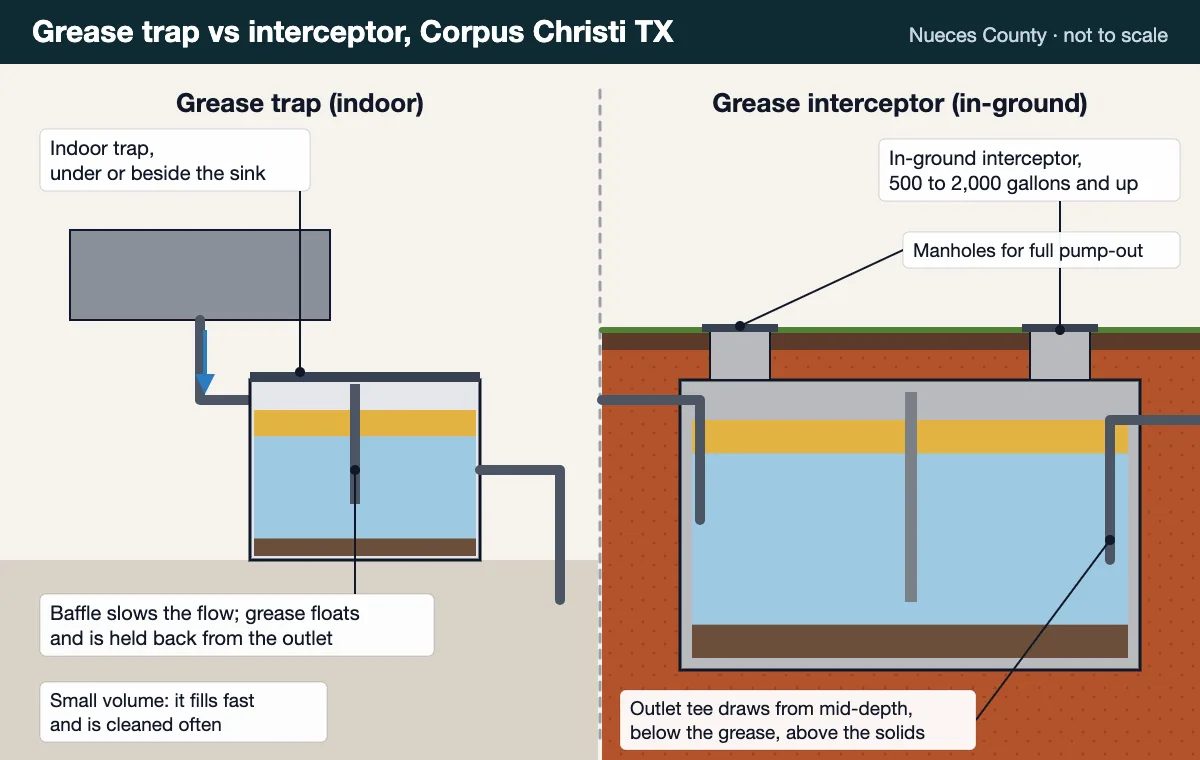
Grease trap cost in Corpus Christi starts with size: an indoor trap is a short visit, an in-ground interceptor is a full vacuum-truck job.
These are typical ranges for the Corpus Christi and Coastal Bend market for a full cleaning, meaning complete evacuation plus scraping, back flushing, inspection, refill, and the signed manifest. They are a planning guide, not a quote. Your actual number comes once the tank, the access, and the history are known.
20 to 50 gallons
Indoor under sink
$150 to $300
per service
Bars, coffee shops, sandwich counters, small taquerias. Fast service, short interval.
75 to 100 gallons
Indoor under sink
$200 to $500
per service
The most common size in independent Corpus Christi restaurants. Usually monthly.
500 to 750 gallons
Outdoor in ground
$300 to $700
per service
Single tenant pads and smaller strip centre sites. Manhole access from the lot.
1,000 to 1,500 gallons
Outdoor in ground
$500 to $1,100
per service
Full service restaurants, hotel kitchens, shared centre interceptors along SPID.
2,000 gallons and up
Outdoor in ground
$900 to $1,500+
per service
Schools, hospitals, hotels, arena concessions, high volume seafood houses.
The number that tells you whether you got a full clean
Volume removed, printed on the trip ticket. A genuine full pump-out on a 1,000 gallon interceptor removes close to 1,000 gallons, because the water column leaves with the grease and the sludge. Tickets that repeatedly show 200 or 300 gallons on a 1,000 gallon tank are documenting a skim, whatever the invoice calls it.
What moves your price inside the band
Gallons actually removed
Disposal is charged by volume, so the load size is the biggest single driver. A tank that gets emptied every month produces a predictable load. A tank emptied once a year produces a much bigger and much harder one.
Access
How far the truck can park from the tank determines how much hose has to be run and how long setup takes. Downtown and Water Street sites with alley only access, tight service yards, and restricted loading windows cost more time than a strip centre with the manhole twenty feet from a parking space. Island and bayfront sites add travel.
Time since the last genuine full clean
A compacted solids layer does not flow. It has to be broken up, sometimes with water added to mobilise it, before the vacuum will move it. On a badly neglected tank this can double the time on site.
Lid and frame condition
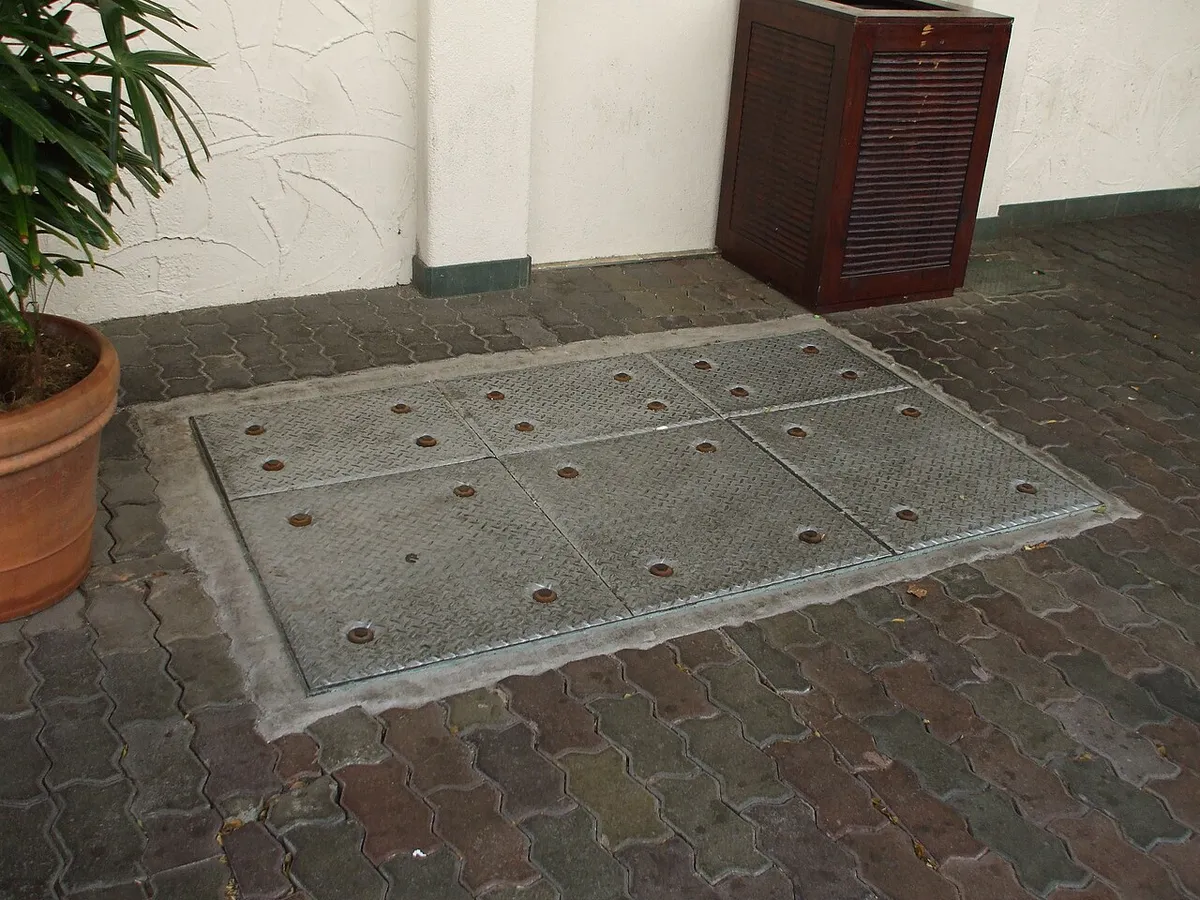
Specific to coastal sites and genuinely significant here. Corroded or seized lids on outdoor interceptors near the bay take real time to free. That is labour, and it should be disclosed rather than appearing as a mystery line.
Scheduling
A route slot booked in advance is the cheapest way to buy this service. A same day priority visit costs more, and an out of hours emergency costs more again, because somebody is being pulled off a planned day.
Line items worth questioning
Ask what each line item is for. Per-gallon overage above an unstated assumed volume is the classic one to question.
Disposal fee shown separately with no volume figure. Ask for the gallons. Disposal is priced by volume, so a fee without a volume is not auditable.
Baffle scraping or line flushing as an extra. These are part of a cleaning, not an upsell. If they are extras, the headline price is not a cleaning price.
Enzyme or bacteria dosing programs. Additives emulsify grease so it leaves the trap instead of being captured. Paying monthly for that is paying to defeat your own equipment.
Mobilisation or fuel surcharges appearing only on the invoice. Fine if quoted, not fine if introduced afterwards.
Long contract terms with early termination charges. A route slot should be a schedule, not a lock in.
Per gallon overage above an unstated assumed volume. If there is an included volume, it should be stated up front.
Annual cost, which is the number that actually matters
Annual cost is price per visit times visits a year, and the visits come from the measured fill rate, not a default.
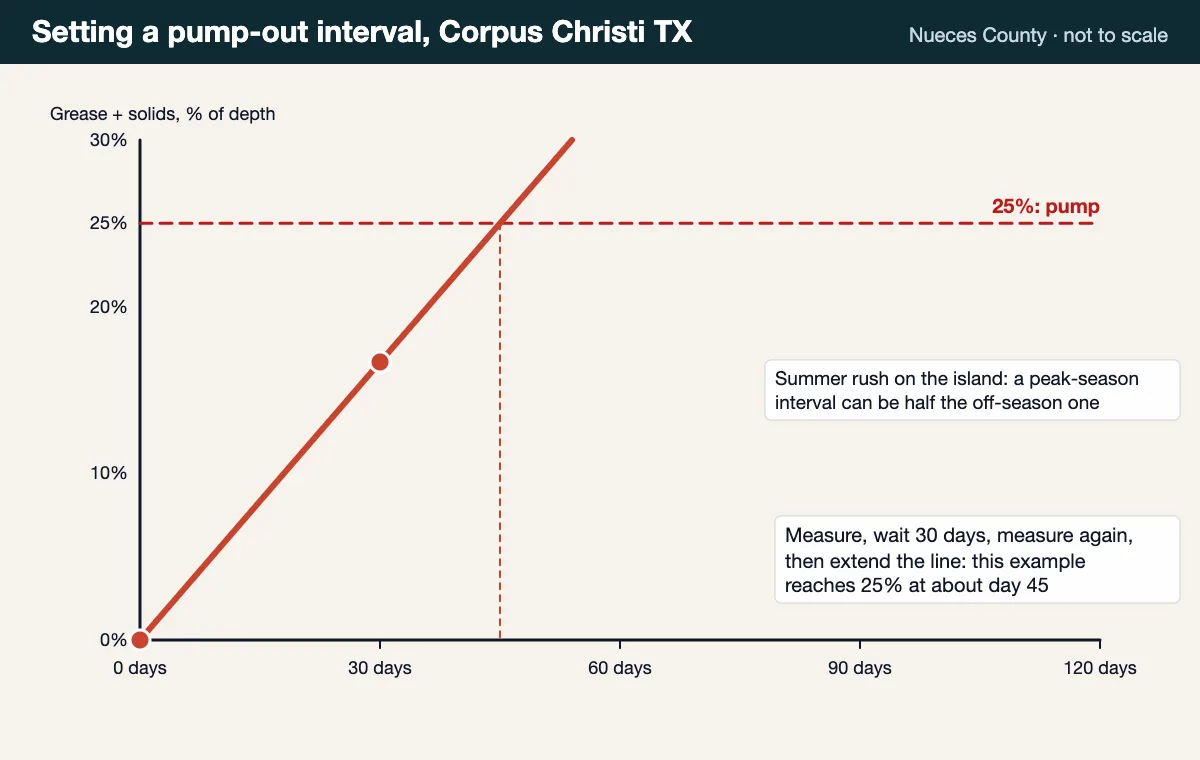
Per visit pricing is the wrong lens. What you are budgeting is a year of compliance. A 100 gallon indoor unit at 250 dollars on a 30 day cycle is about 3,000 dollars a year. The same unit at 300 dollars on a 45 day cycle is about 2,400. That looks like a saving until the longer interval puts the tank over the 25 percent line for part of every cycle, grease reaches the lateral, and one blocked line plus a lost Saturday night erases several years of the difference.
The correct interval is whatever your measured loading rate says it is. The frequency guide shows how to work it out from two measurements. Budget that interval, not the cheapest one you can negotiate.
How quoting works
Send the trap size if you know it, the address, and roughly when it was last serviced. If you do not know the size, tell us whether the access is a lid under a sink inside or a manhole cover outside, and roughly how many covers you do. You get a firm number before anything is dispatched, including on emergency calls. If the tank turns out to be materially different from what was described, you should be told what it changes before work continues.
Four things move the number. Gallons actually removed, which is not always the nominal tank size. Access, meaning how far the hose has to run and whether the lid opens. Time since the last genuine full clean, because a compacted solids layer has to be mobilised before it will pump. And scheduling, because a same day emergency slot costs more than a route slot booked in advance. A well maintained tank on a regular cycle sits at the bottom of its band. A neglected one sits at the top or above it.
Is the cheapest quote usually the best value?
Often it is the most expensive thing in the building, because the cheapest quotes in this market are frequently skims priced as cleans. If a quote for a 1,000 gallon interceptor is half what everybody else is asking, ask what volume they intend to remove and whether baffle scraping and line flushing are included. A partial service at half price that leaves you with a blocked lateral has cost you far more than the difference.
What should be included in the headline price?
Full evacuation of the tank, wall and baffle scraping, inlet and outlet back flush, baffle inspection, refill to operating level, and the signed trip ticket. If any of those are quoted as extras, add them in before comparing. A pump only price is not the same product as a cleaning price even though the invoice may use the same word.
More covers usually means more compartments and more gallons, and a bigger line on the quote.
Does a first clean on a neglected trap cost more?
Yes, and it should. A tank nobody has fully emptied in two years has a hardened cap and a compacted bottom layer that takes real time to break up and remove, sometimes needing water added to mobilise it. That is a one time catch up cost. Once you are on a proper interval, routine visits price normally.
Are there hidden fees I should watch for?
Ask specifically about disposal fees, fuel or mobilisation surcharges, after hours premiums, and per gallon overage above an assumed volume. None of those are inherently unreasonable, but they should be disclosed in the quote and not appear for the first time on the invoice. Ask for an all in number before dispatch.
Is it cheaper to service less often?
Per visit, obviously. Over a year, usually not. Stretching intervals produces harder loads that take longer to pump, accelerates capacity loss from compacted solids, pushes grease into your lateral, and eventually produces a blockage and a lost service night. The arithmetic almost always favours the correct interval over the longest one you can get away with.